
Carroll County Criminal Court Cases
The Iowa District Court for Carroll County is the county's unified trial court. Carroll County district judges hear felonies and other major matters. Associate district judges and magistrates handle assigned indictable misdemeanors, simple misdemeanors, traffic matters, and early criminal proceedings. A magistrate may conduct an initial appearance or address release conditions, but those acts remain part of the state court system. Research found no separate online municipal court database for Carroll, Manning, or Coon Rapids.
The Clerk of District Court is the court-file custodian. The Carroll County clerk maintains the case number, docket, public pleadings, orders, judgment, sentence, and financial entries. The Carroll County Attorney decides what accusation to file, yet that office is not the official docket keeper. This split matters. A police report can describe an alleged event, while the Carroll County criminal court case shows which charge was actually filed and how the court disposed of it.
Inside Carroll County Criminal Court
Carroll County prosecutions use Iowa case numbers and the statewide docket. The case header identifies the county, case type, filing date, and current status. Each charge has its own code, description, level, and outcome. Scheduled events can identify a date, time, event type, judicial officer, and court location. Financial panels may show fines, costs, restitution categories, payments, or balances when those fields are public.
Case identity should rest on more than a name. Compare the county, case number, filing period, and other non-sensitive facts. Common names and spelling variants can yield the wrong file. The Iowa Judicial Branch court-search entry also distinguishes public access from expanded subscription features. A basic search can expose useful docket data without making every underlying document downloadable.
Searching Carroll County Case Records
Use Iowa Courts Online as the first search channel. A known Iowa case number is the strongest key. If it is unavailable, combine the party name with Carroll County, the criminal case category, and a useful date range. Very recent Carroll County filings may need time to appear. Older records, certified copies, and restricted online fields may require direct help from the clerk.
- Open the trial-court search rather than the appellate tab.
- Enter the case number, or search the party's first and last name.
- Select Carroll County and narrow the case type or date range.
- Open the detail view and read every charge and docket event.
- Give the clerk the case number and document title when requesting inspection, a copy, or certification.
| Field Label | Type | Required | Notes |
|---|---|---|---|
| Trial Court / Appellate Court | Navigation | Mode choice | Use trial court for Carroll prosecutions |
| Case Number | Text | No | Strongest identifier when known |
| Last Name / Company Name | Text | Mode-dependent | Spelling and party naming matter |
| First Name | Text | No | Helps narrow common names |
| County | Dropdown | No | Select Carroll |
| Case Type / Date Range | Filters | No | Useful for criminal files and older matters |
Carroll County Court Search View
The official Carroll County search interface shows how Iowa centralizes trial-court access. The Iowa Courts Online search form is the source for the view below.
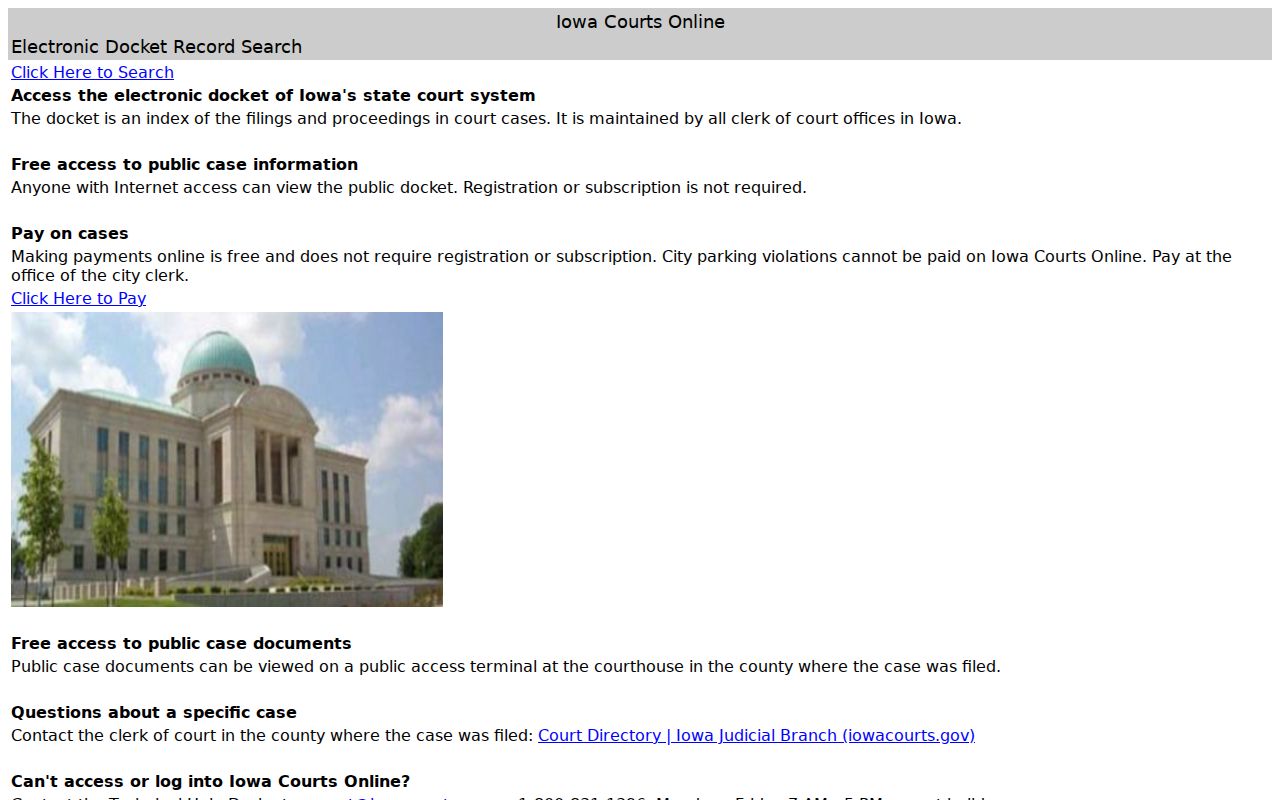
The county filter and case-number route help separate a Carroll County case from a similar name elsewhere in Iowa. Open the full detail screen before drawing a conclusion from a result list.
Inside a Carroll County Case File
A Carroll County court file is a chain of court acts, not one summary sheet. Start with the charging document and docket. Iowa prosecutors commonly use a trial information, which is a formal charging paper filed by the prosecutor, rather than a grand-jury indictment. Then trace amendments, pleas, motions, hearings, judgment, and sentence. Public financial and schedule data can help confirm that the correct file is open.
| Case Number & Court | Unique Iowa case identifier, Carroll County, case type, filing date, and status |
|---|---|
| Charging Document | Complaint, trial information, indictment, or an amended public charge |
| Docket Entries | Chronological list of appearances, filings, hearings, orders, and compliance events |
| Hearing Dates | Scheduled date, time, event type, and location when publicly posted |
| Disposition & Judgment | Separate outcome for each count, including dismissal, acquittal, or conviction |
| Sentence & Conditions | Confinement, probation, fines, costs, restitution, and other public terms |
Note: A docket entry can remain visible even when the document behind it is confidential or unavailable to the public.
Reading Carroll County Case Outcomes
Never treat the case caption as the outcome. One Carroll County case can include several charges, and each can end differently. A prosecutor may amend an offense, dismiss one count, and obtain a plea on another. Read the disposition beside each charge. “Disposition” means the court's result for that count. “Dismissal” ends that charge without a conviction, while “conviction” is a judgment of guilt after a plea or trial.
The Carroll County docket adds context. It can show when counsel appeared, when a trial information was filed, whether an arraignment occurred, and when judgment entered. A plea agreement is a negotiated resolution that still needs court action. A deferred judgment is different from a standard conviction because Iowa law lets the court defer judgment while conditions are completed. Its later confidentiality effect should not be confused with deletion of every agency record.
- Trial information
- Iowa prosecutor's formal charging document, often used instead of an indictment.
- Arraignment
- The hearing where the accused receives the formal charge and enters a plea.
- Disposition
- The final result of one charge or the case.
- Docket
- The court's chronological list of events and filings.
How a Criminal Case Moves
Carroll County criminal court cases follow Iowa procedure. After an arrest, Iowa's court guide states that the person appears before a magistrate within 24 hours. The court addresses charge notice and release conditions. A preliminary hearing may follow unless it is waived or displaced by formal charging. The prosecutor then files a trial information or, less often, proceeds by indictment. Arraignment brings the plea, followed by discovery and pretrial motions.
Case flow: Charges Filed › Arraignment › Pretrial › Plea or Trial › Disposition › Sentencing
A negotiated plea can end the trial stage, but judgment and sentencing still create distinct Carroll County docket events. Appeals and postconviction proceedings may extend the file. The booking allegation does not control this chain. For the earlier custody record, the Carroll County arrest lookup explains the sheriff, jail, and agency channels.
Carroll County Charges Can Change
A booking charge records the arresting agency's basis at intake. The County Attorney later decides whether and what to prosecute. That decision can narrow, replace, or decline the initial allegation. The trial information is therefore the better source for charges actually filed, while the final charge rows and judgment show what survived to disposition.
This distinction also explains why a court search and an Iowa DCI history may not match at once. DCI organizes fingerprint-supported arrest cycles and reported dispositions. Iowa Courts Online organizes filed cases and judicial events. An arrest without submitted fingerprints can be absent from DCI, while a filed Carroll County criminal case can still be present in the court system. Compare sources rather than forcing them into one timeline.
Missing Carroll County Court Filings
A public docket entry does not guarantee a downloadable image. Confidential victim data, juvenile material, sealed warrants, protected identifiers, and other restricted documents can be withheld. The Judicial Branch restricted-record policy controls electronic access. Redaction removes protected facts from an otherwise open record; sealing or confidentiality can limit the document itself.
When a filing is unavailable, note the Carroll County case number, docket date, and document title. Ask the Clerk of District Court whether it may be inspected, copied, certified, or retrieved from an archive. Confirm the current copy charge before ordering. Older guidance mentioned a per-page amount, but the research did not verify it as the current local fee. A precise request avoids needless retrieval and helps the clerk identify the right file.
Carroll County's official courthouse history offers one useful fact for archive research. The county reports that an 1886 courthouse fire spared the vaults and their records. Files were moved to temporary quarters before a later courthouse opened. That does not establish that every old criminal filing is indexed online, but it does mean a blank digital result should lead to an archive question rather than an assumption that the fire destroyed the source.
Case Record Access & Restrictions
Iowa Code chapter 22 supports the right to inspect and copy public records, subject to statutory confidentiality. Iowa Code chapter 692 separately governs criminal-history data held by DCI. Court files also follow Iowa Judicial Branch rules for restricted documents and case types. Those systems answer different questions, so a DCI result should not replace the Carroll County court docket.
The practical access chain is simple. Search the public docket, ask the clerk for a specific filed item, and request an explanation of any legal restriction. Juvenile records are generally confidential. Protected victim or minor data can be redacted, and sealed material is not opened merely because a case shell appears. If a name search yields no result, check spelling, county, and filing lag before assuming that no case exists.
A denial or redaction should rest on a legal basis. Ask whether the public portion can be separated from confidential material. Carroll County's open-records policy follows that approach for county records, while court access remains controlled by Judicial Branch rules. Inspection, an ordinary copy, and a certified copy are also different requests. State the purpose of the document only when an official form requires it, and ask the clerk which product fits the need.